#1 in Books > Comics & Graphic Novels > Graphic Novels > Educational & Nonfiction
#3 in Books > Religion & Spirituality > Islam > Women in Islam
#4 in Books > Comics & Graphic Novels > Biographies & History Graphic Novels
More about the author
Marjane Satrapi was born in 1969 in Rasht, Iran. She grew up in Tehran, where she studied at the French school, before leaving for Vienna and Strasbourg to study decorative arts. She currently lives in Paris, where she is at work on the sequel to Persepolis. She is also the author of several children's books.
Editorial Reviews
Review
"A memoir of growing up as a girl in revolutionary Iran, Persepolis provides a unique glimpse into a nearly unknown and unreachable way of life... That Satrapi chose to tell her remarkable story as a gorgeous comic book makes it totally unique and indispensable."
--Time
About the Author
Marjane Satrapi was born in Rasht, Iran. She now lives in Paris, where she is a regular contributor to magazines and newspapers throughout the world, including The New Yorker, and The New York Times. She is the author of Embroideries, Chicken with Plums, and several children's books. She cowrote and codirected the animated feature film version of Persepolis.
Customer Reviews
4.0 star
A very different kind of novel for me
ByCamp Runamokon January 26, 2016|Verified Purchase
This is a type of book I've never read before. A graphic novel is essentially just a very long comic book, with a typically more serious plot line. This version combines the two Persepolis novels in to one, which was well worth the extra $5. The combined narrative is an autobiographical novel about growing up in Iran during before, during, and after the revolution. The author currently lives in Paris, writing for the NY Times and other publications. Satrapi made a comic film out of the books. It rates a high 3.9 overall on Netflix, so I plan to watch it.
The book itself was pretty interesting. The author grew up in Iran and Austria, both with and without her parents - being homeless at one point, so she had an interesting upbringing. But I'm not sure overall what to think of the concept of a biographical novel, assuming this is representative of the genre. It feels like it's a book made up of soundbites, so it just didn't grab me like a normal novel would. But the story itself it pretty fascinating. What a wild and interesting life. If you want to get a taste of the book, check out Satrapi's blogs in the NY Times. If you find the graphic blogs interesting, which I did, you will likely find the book worth reading.
5.0 star
Historical Non-Fiction for the Win!
ByMargoon March 28, 2016|Verified Purchase
Book Review
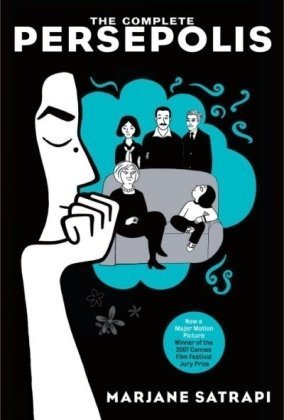
Satrapi, M. (2007) The complete Persepolis. New York, NY: Pantheon Books.
After reading Marjane Satrapi’s graphic memoir, Persepolis, I believe it is in the best interests of our students to add the book to our available reading list. Persepolis is Satrapi’s account of growing up during the Iran-Iraq War (1980-88) that almost immediately followed the Iranian Revolution (1979). Satrapi is an Iranian woman who left Iran to attend high school in Vienna, later returned to Iran to marry, and eventually moved to France where she wrote Persepolis. The memoir serves as a bildungsroman for Satrapi, covering her life as she leaves primary school and enters high school; we see Satrapi grappling with the woman she wants to become in light of where she comes from. Persepolis also serves as a piece of literary historical non-fiction because the backdrop of Satrapi’s coming of age is amidst a pivotal point in Iranian (and Iraqi) history, and this history is central to the plot line of Satrapi’s memoir. Persepolis has also won a fair share of awards. It was a New York Times notable book, Times Magazine’s “Best Comix of the Year” (2004), and a best-seller across the country. The book, originally written in French, was adapted into film, and the film version won the Cannes Jury Prize, the César award for best writing, the César award for the best first feature film, and the Sutherland trophy. The film adaptation was also nominated for an Academy Award for best animated feature film.
Despite the accolades both the film and graphic memoir received, Persepolis is in the top 10 of the American Library Association’s 2014 “Frequently Challenged Books” list. The ALA informs us that the rationales that have been provided for banning the book include gambling, offensive language, and its political viewpoint. The ALA also says that Persepolis has been called “politically, racially, and socially offensive” and that it has “graphic depictions.” There is truth to these claims. Persepolis takes place as Satrapi grows up amidst the Iran-Iraq war. War, by its very nature, brings about political viewpoints that some students and their parents may disagree with. The book also contains offensive language, and portrays the ramifications of war and includes “graphic depictions” as a result. The National Council of Teachers of English (NCTE) in its guidelines on “The Students’ Right to Read” (2012), argues, “Literature about ethnic or racial minorities remain ‘controversial’ or ‘objectionable’ to many adults…. “Though nominally, the criticisms of racial or ethnic literature have usually been directed at ‘bad language, ‘suggestive situations,’ ‘questionable literary merit,’ or ‘ungrammatical English,’ the underlying motive for some attacks has unquestionably been racial.” Using the coded language the NCTE provides, we can see that the reasons given to the ALA as evidence supporting a book ban and/or challenge appear racial. The complaints do not say, “We should ban this book because it is about an Iranian woman,” but the codes found in words like “offensive” point to a racially-based book ban.
This kind of censorship is inappropriate and unfair to our students, who deserve to have historical events contextualized in multiple forms (movies, graphic novels, novels, short stories, documentaries, and art to name a few forms) and to have students from multiple cultures represented in texts. English Language Arts programs is, “…not one instructional resource, but many; not one curriculum objective, but several” (Guidelines for selection of materials in English language arts programs, 2014). The use of Satrapi’s text allows for many objectives to be met simultaneously:
1. It is historical non-fiction, which allows it to be taught as an informational text rather than as literature. It is also naturally interdisciplinary, which allows for and encourages complementary teaching across Social Studies and English Language Arts classes.
2. It is beautifully written. Even though it is classified as an informational text, many of the literary devices English Language Arts teachers long to discuss can still be discussed.
3. As a graphic narrative, it can be taught to students who read at a wide range of Lexile levels. Visual learners will also benefit. Its graphic form also allows it to become a “high-interest” text when it probably wouldn’t be in other circumstances
4. As a historical narrative covering the Iran-Iraq War from the perspective of an Iranian woman, it meets the Common Core Standard for “diverse cultures.”
5. As a memoir written by a woman, it allows educators to disrupt the male-centered curriculum so often seen in classrooms across the country
6. Persepolis can easily be included in a text set with other texts. It can be used in a unit on war, the Iran-Iraq War specifically, women in the Middle East, women’s rights, and fights for freedom.
Depending on the instructional context used by the instructor, Persepolis can meet many curriculum needs simultaneously, while widening the worldview of American-centric readers. In schools with high populations of immigrants and refugees, Persepolis helps provide a face that is often much more like theirs in a sea of literature dominated by dead white men.
As with any highly-challenged book, it is probably always a good idea to send parents a permission slip in advance that provides them with 1) an opportunity for their student to do an alternate assignment instead 2) a rationale for why you believe the text is worthy of study and 3) reasons why the book is challenged. It’s certainly possible that parents will balk at the idea of their children reading a book that some consider “offensive,” but I have faith that with simple explanations and the ability to change their mind, the vast majority of your students will be able to read texts as important as Persepolis.
5.0 star
Wonderful, but not nearly enough!
Bykaduzyon May 14, 2017|Verified Purchase
I've been a fan of this movie for over a decade, and I'm still not sure why I waited this long to finally read the original graphic novels. They are, of course, just as good. Fascinating and quite thought-provoking. My only wish was that Ms. Satrapi had written even more.
4.0 star
An interesting and revealing memoir from a girl's perspective growing up in revolutionary Iran.
ByJoseph J. TruncaleTOP 1000 REVIEWERon March 22, 2013|Verified Purchase
This type of book is usually not my come of tea. However, when I heard some of the schools in the Chicago area were attempting to ban the book from their reading list, I decided to see what all the fuss was about. I discovered this book was a memoir from a woman who grew up in revolutionary Iran. This book was obviously designed for a younger group because it is in a comic book type of format, which actually made it an enjoyable read because of the illustrations on each page.
The Complete Persepolis by Marjane Satrapi is a 341 pages long and the story begins in 1980 when the author was 10 years old. It tells about when the Islamic revolution took place in 1979 and how all women had to wear a veil. The story moves on to explain the many changes that occurred in Iran while she was growing up.
The author relates how close she was to her family and how they did their best to protect her from the changes going on in Iran over the years. Her parents sent her to Austria to learn French and she also learned some German as well. This is basically an autobiography of the author and I think it is a book American youths should also read in order to understand the dangers of religious extremism. The author now lives in Paris, France and is still writing.
In conclusion, even though I think this book will appeal to women more than men, I still think it was a good read. If you want to find out how women (and anyone else who did not follow every rule) were treated for breaking any of the very strict religious rules in Iran, you might want to read this book.
Rating: 4 Stars. Joseph J. Truncale (Author: Haiku Moments: How to read, write and enjoy haiku)