#206 in Books > Science & Math > Biological Sciences > Anatomy
#258 in Books > Science & Math > Evolution
#850 in Books > Health, Fitness & Dieting > Diseases & Physical Ailments
Editorial Reviews
Amazon.com Review
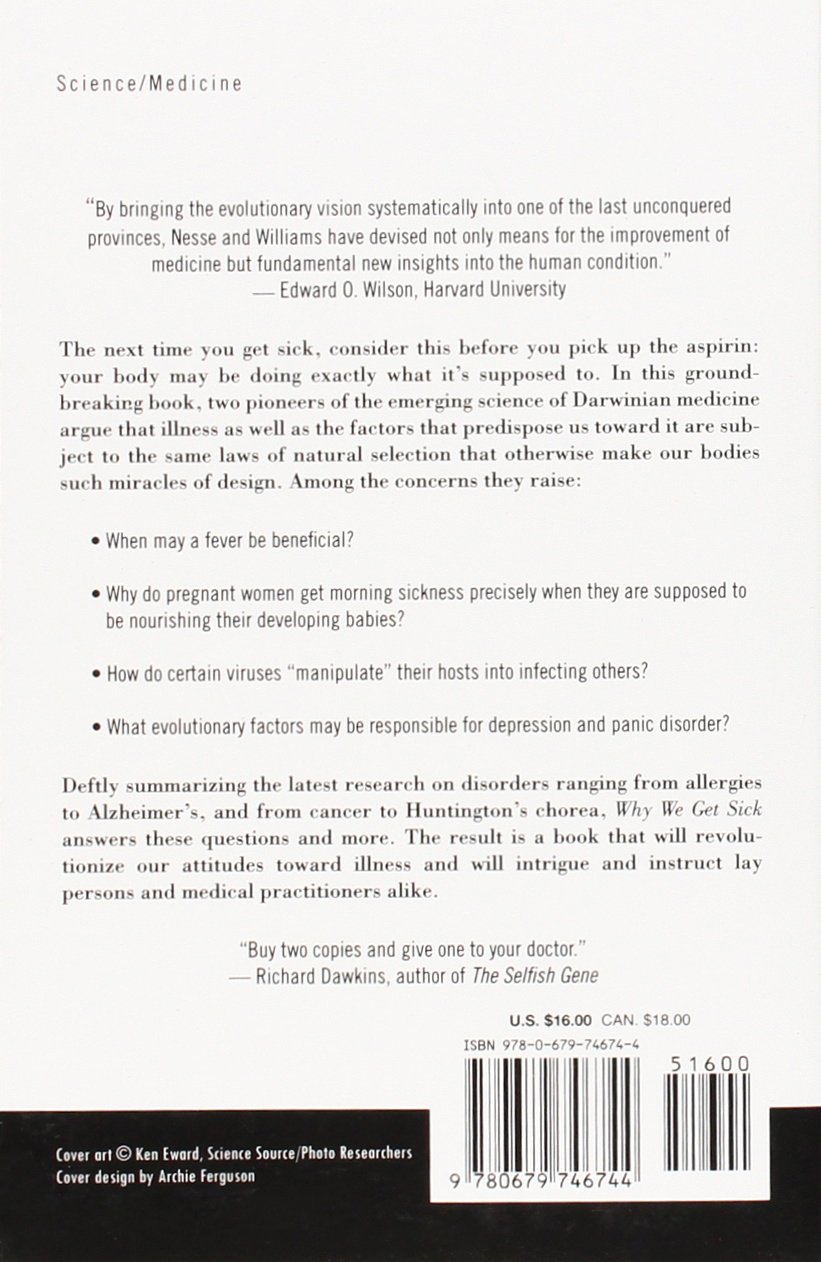
Is our tendency to "fix" our bodies with medicine keeping them from working exactly as they're supposed to? Two pioneers of the emerging science of Darwinian medicine argue that illness is part and parcel of the evolutionary system and as such, may be helping us to evolve towards better adaptation to our environment.
From Publishers Weekly
Nesse and Williams have written a lively discourse on the application of the principles of evolutionary biology to the dilemmas of modern medicine. Nesse, a physician and an associate professor of psychiatry, and Williams, a professor of ecology and evolution, provide a primer on Darwin's theory of natural selection. They explain that the functional design of organisms-e.g., our bodies-may suggest new ways of addressing illness. The book begins with a look at the causes of disease and their evolutionary influences. But the book mainly assesses the concept of adaptation by natural selection, and illustrates the ways Darwinian thinking can be applied to medical problems. As one example, the authors examine the use of penicillin over the past 60 years against bacterial infections. The book's quirky information may speak to a broad audience: researchers, for instance, have found that relatives of schizophrenics have an unusually high frequency of inclusion in Who's Who-which may counterbalance drawbacks of the disorder in evolutionary terms. The tendency toward child abuse, too, may be influenced, the authors say, by evolution and the passing on of genes. And there may well be an evolutionary reason to welcome morning sickness, they argue: nausea and food aversions during pregnancy apparently evolved to impose dietary restrictions on the mother so as to correspond with fetal vulnerability and, thereby, minimize fetal exposure to food toxins.
Copyright 1994 Reed Business Information, Inc.
--This text refers to an out of print or unavailable edition of this title.
Customer Reviews
5.0 star
An evolutionary approach to understanding medicine
ByPeter Grayon April 23, 2000
Slightly modifying an oft-quoted line by the famous biologist Dobzhansky, Nesse and Williams conclude, "After all, nothing in medicine makes sense except in the light of evolution." In this lucidly written book, the authors make this assertion throughout. They lay out principles for interpreting aspects of human health from an evolutionary perspective. For example, some of the body's responses can be viewed as adaptive defenses (e.g. fever), others the products of novel environments (e.g. Sudden Infant Death Syndrome, or SIDS). The authors raise intriguing examples, from adaptive withholding of the body's iron stores to pregnancy sickness, that put flesh on the bones of these principles. This book does a fine job of overviewing the ways in which an evolutionary perspective can contribute to a richer understanding of medicine than the more proximate (e.g. what are the chemical and genetic bases to schizophrenia?) focus alone can provide. For this reason, it may long be seen as a seminal contribution.
5.0 star
One of my favorite books of all time
ByWilliam J.on May 12, 2017|Verified Purchase
One of my favorite books of all time. The authors distinguish between symptoms of disease, versus the bodies adapted response. In medicine frequently all symptoms are treated equally, but some are actually adaptive, and will help us to get better faster. This book was also the first time I was exposed to the idea that infections can significantly alter behavior. A mouse no longer afraid of a cat! Today we even find examples of this happening in humans....
5.0 star
For thinking people
BySteve Diputon November 13, 2015|Verified Purchase
It is so refreshing to get a wider view of why we get sick instead of treating it as inscrutable Fate (even if subconsciously).
Succinct and easy to understand. If you want to think and act, to take things into your own hands, and all this science-based not one of these idiotic fake books by swindlers who propose weird solutions for the gullible. This is a book for someone who actually wants to think.
It is endorsed by Professor Robert Ornstein, a giant of deep thinking about the brain and the body relationship, about consciousness, about who we are, what how we think and what we are aware of from the myriad od aspects of the universe.
5.0 star
Really interesting, definitely worth reading
ByChristinaon May 31, 2017|Verified Purchase
Extremely fascinating and very readable (to someone outside the medical field like me) overview of the role of evolution in disease and medicine.
4.0 star
Good so far
ByAmazon Junkyon March 30, 2017|Verified Purchase
So far it is interesting. To me actually, it is common sense, considering that evolution as effected eveyrthing that is.
4.0 star
What's for dinner?
ByMr. Joeon September 2, 2007|Verified Purchase
"If you are starving in a rain forest, eat the camouflaged frog that is hidden in the vegetation, not the bright one sitting resplendent on a nearby branch."
At first glance, this quote from WHY WE GET SICK wouldn't seem to be relevant to the topic. But since the hypothesis of the book is that evolution and natural selection govern the senescence of aging and the physiological responses to diseases and mortally competitive environments, the fact that the gaudier frog has evolved with potent internal poisons that (should) signal "danger" to any potential predator makes the connection vis-a-vis both the amphibian's toxin and the starving hiker whose internal defense mechanisms may at least cause vomiting and diarrhea if frog's legs make it onto the dinner menu.
As authors Randolph Nesse and George Williams summarize:
"First, there are genes that make us vulnerable to disease ... Most deleterious genetic effects ... are actively maintained by selection because they have unappreciated benefits that outweigh their costs ... Second, disease results from exposure to novel factors that were not present in the environment in which we evolved ... Third, disease results from design compromises, such as upright posture with its associated back problems ... Fourth, ... natural selection ... works just as hard for pathogens trying to eat us and the organisms we want to eat. In conflicts with these organisms, as in baseball, you can't win 'em all. Finally, disease results from unfortunate historical legacies ... the human body must function well, with no chance to go back and start afresh ... Susceptibility to disease ... cannot be eliminated by any duration of natural selection, for it is the very power of natural selection that created them."
Under the umbrella of natural selection, the authors include everything from the obvious and non-arguable, such as fever as a mechanism to kill invading pathogens with heat, to the less obvious and perhaps debatable, such as the instinctive desire of small children to remained unweaned from mother's breast, which serves to prolong lactation and ensures that Mom won't become pregnant with a potential rival. Other examples fall into the category, Gee, Why Didn't I Think of That, including the morning sickness of pregnancy, which serves to prevent Mom from ingesting toxins during that vulnerable period when the unborn child is experiencing peak organ formation, and the causative agent of gout, uric acid, the build-up of which also protects the body from the aging effects of oxidative damage. Then there's cancer, which wouldn't be a problem had we not tissue cells that grow and regenerate. And did you know that premature ejaculation in the male is ostensibly selective, in an evolutionary sense, for those men that can get the gene transfer job done, so to speak, and then flee before the female's alpha male partner shows up to brain the interloper with a knotty pine cudgel?
Nesse and Williams lucidly present an unconventional paradigm of medicine, a different perspective from which to view disease and aging, that's only accasionally preachy. They rue the fact that it's not part of the mainstream, and argue for its inclusion in the curriculum of the country's medical schools. They fail to mention what I think is the more practical route to widespread acceptance, i.e. when it can make the medical industry lots of money.
Hey honey! How about some frog legs for dinner? I see a bright green one with yellow and red speckles perched in the carrotwood out back!