#579 in Books > Politics & Social Sciences > Philosophy > Social Philosophy
#3071 in Books > Politics & Social Sciences > Philosophy > Ethics & Morality
Editorial Reviews
Review
"One of the truly outstanding books in the intellectual history of the world...A global manifesto of profound significance to the interdependent world in which we live. It is indeed a book of amazing reach and contemporary relevance."
-Amartya Sen, from the Introduction
Book Description
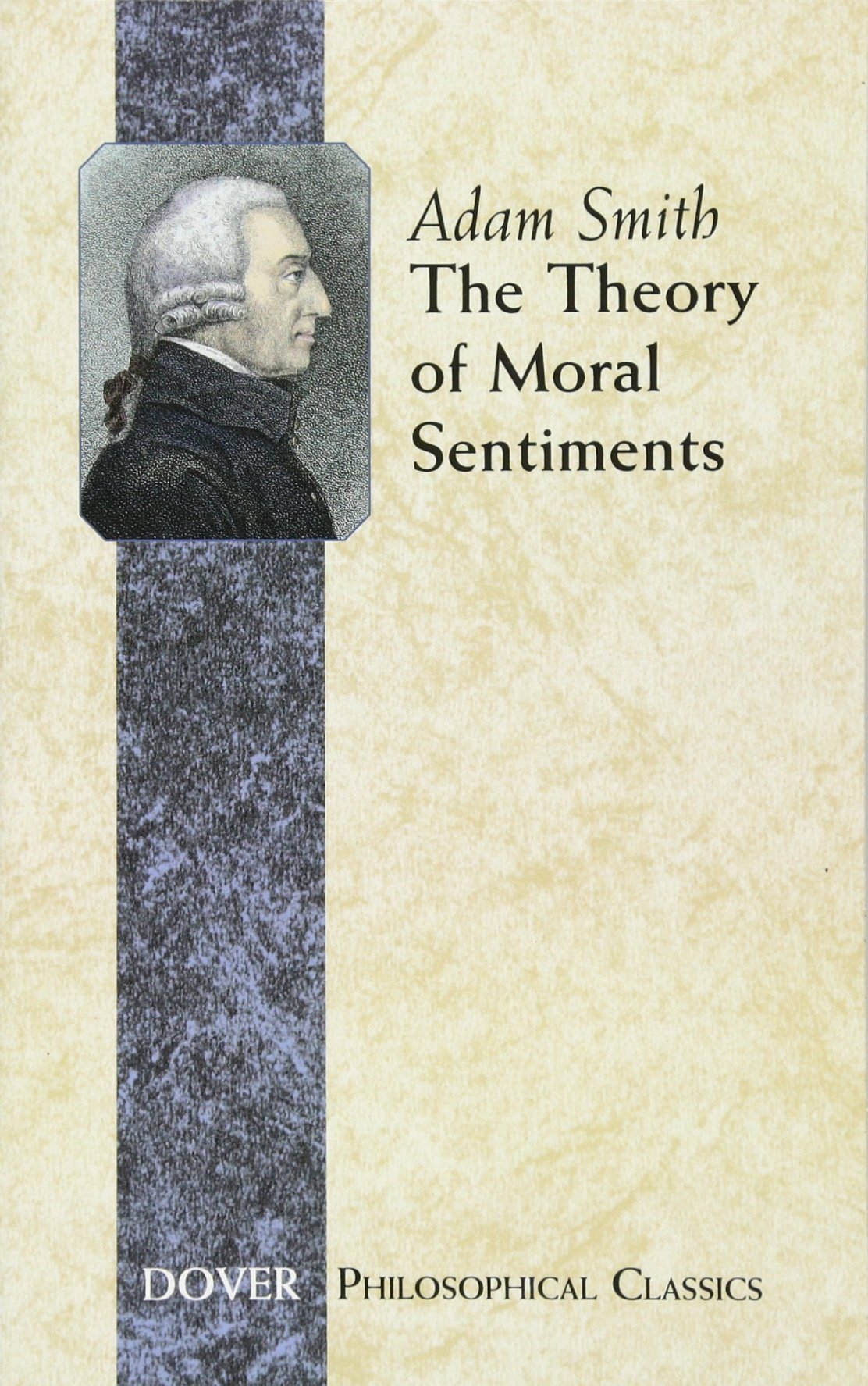
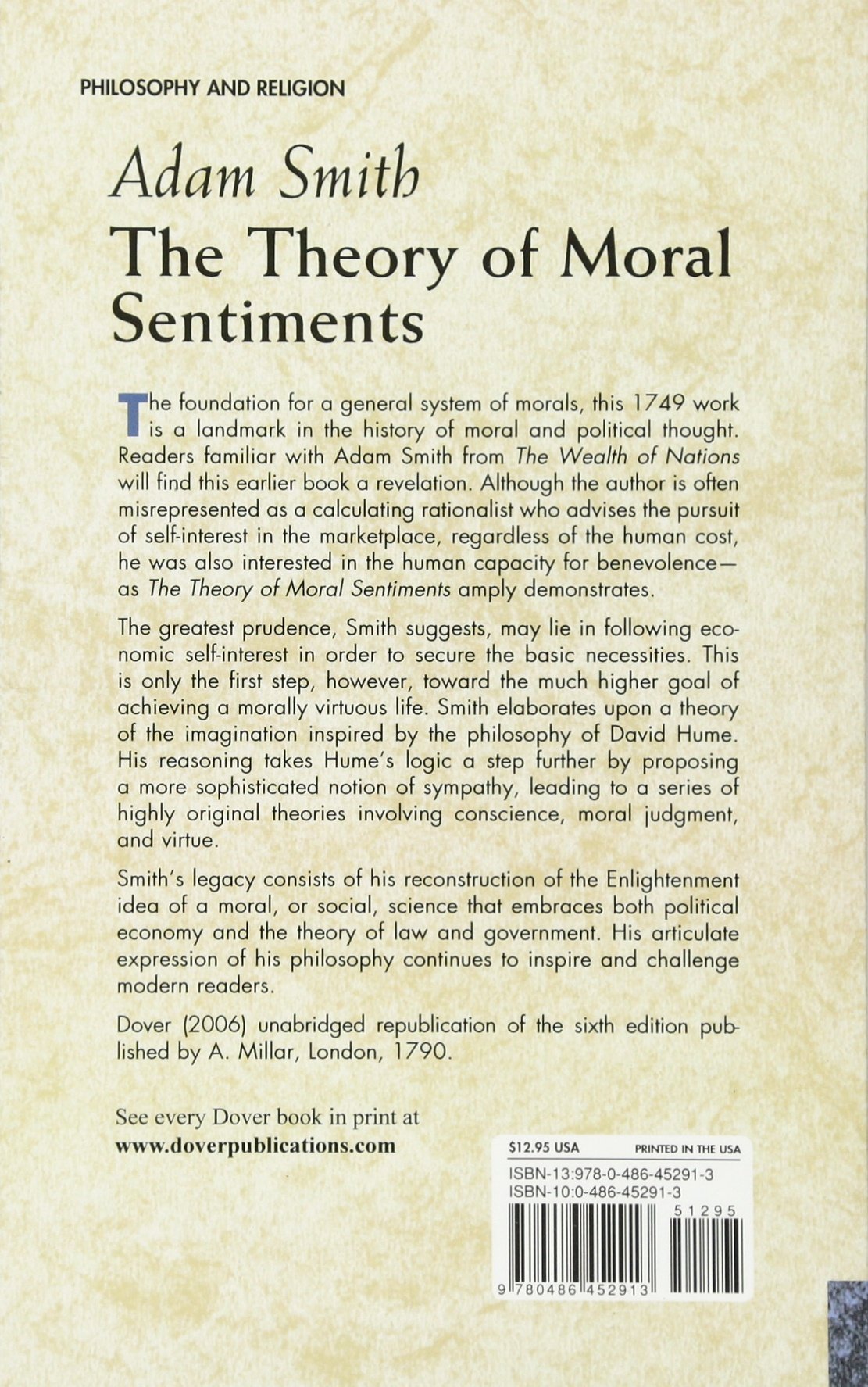
Adam Smith's Theory of Moral Sentiments (1759) lays the foundation for a general system of morals, and is a text of central importance in the history of moral and political thought. By means of the idea of sympathy and the mental construct of an impartial spectator, Smith formulated highly original theories of conscience, moral judgment and the virtues. This volume offers a new edition of the text with helpful notes for the student reader, together with a substantial introduction that sets the work in its philosophical and historical context.
Customer Reviews
1.0 star
Kessinger edition contains about 10% of the actual book
ByHandyGuyon June 26, 2015|Verified Purchase
As so many people say "How can I give it zero stars?"
Note that this is a review of the "Kessinger Publishing, LLC" product and NOT a review of Smith's original work.
The Kessinger "book" is a bad reprint of a couple of chapters of Smith's entire "The Theory of Moral Sentiments" and runs less than their stated 60 pages.
For half the price, you can get a brand new complete printed copy (running several hundred pages) or get the whole thing on Kindle for 99 cents.
Kessinger's description that talks about "our commitment for protecting, preserving, and promoting the world's literature in affordable, high quality, modern editions that are true to the original work" is laughable and insulting.
Their market surely must be people who don't know any better. And surely the positive reviewers received a completely different edition from another publisher!
Please remove this edition from Amazon.
1.0 star
just the first section in a nice binding. If you want the entire text
ByC. Adamson October 6, 2016|Verified Purchase
This publication is misleading: not what it is advertised to be...this is only a small part of the entire text by Adam Smith, in fact, just the first section in a nice binding. If you want the entire text, don't buy this rip-off; go on line and print out the entire text content free. I thought a nice bound copy oif this out of print classic work would be nice. Instead, I paid for only 56 pages of a 400+ page work. This product should be a great embarrassment to AMAZON for facilitating its false marketing and distribution.
5.0 star
Excellent book with improved Kindle
ByAsko Korpelaon September 28, 2016|Verified Purchase
There are two aspects in this review. One is about the book and the other about Amazon's contribution to the Revolution in Reading.
First of all the book. I am reading Adam Smith's The Theory of Moral Sentiments the second time and the second time preparing my MyeBooks notes on it. It will be interesting to compare those two in my system of no less than the Revolution in Learning. As professor of economics I have also read Adam Smith's even more famous book The Wealth of Nations, even if half a century later than I should have. His easily recognizable very personal way of writing and suffocating the reader with, least to say, proliferous zunami of detailed text is at the same time entertaining and really suffocating. But also completely convincing. They say about some political leaders that they have the Nile or an Amazon of thoughts. Adam Smith, too. He would deserve of being a big political boss. As he in reality also is. The best economic policy is conducted on the basis of his still valid thoughts on economics, which in turn are based on his Theory of Moral Sentiments presented in this book. No need, and no competence to go into the mydiad of details here. Overwhelming.
Secondly, some words about my first experience with Amazon's new improvements of Kindle. During the five years I have been using Kindle, it has changed, improved a lot. Many times I have had the feeling that Amazon has taken into account the suggestions I have made in my feedback. Perhaps, perhaps not needed, because they have been so obvious that anybody could have requested them and Amazon's skilled programmers could have worked on their own.
Two big improvements I see first time in this book. I do not know the proper term, but name it the 'surrounded screen'. And the X-ray property. By introducing the ingenious toggling between full screen and surrounded screen has brought to the ebook one of the still missing properties of paper book: 'leafing around'. Making the reading a cosy event. I would say that I alternate big screen and surrounded about half and half of the time. It is astonishing that the surrounded can really be read without trouble although it is given with remarkably smaller font. l use the surrounded for speedy reading, seem to grasp the whole screen with one glance, somehow picking the beef quicly, or use surrounded for speeding uninteresting spots of text.
The X-ray property is an excellent supplement for constant looking up in Wiki. An improvement to lookups, because there are summaries of several lookups and sorted list of persons, events etc. But Amazon could easily take a couple of further cock steps forwards. Google maps could be provided in connection to place names. With the fine properties of measuring distance, showing road and giving prepared information in pictures and summaries.
But then there is not but a cock step, but a big leap to be made by Amazon to make Kindle another Revolution of Learning. Not just looking up words in dictionaries but also saving for future needs and memorizing the word definitions just as I have made in MyeBooks. [...]
Five stars without any hesitation.
1.0 star
DO NOT Purchase this General Books Edition
ByRick Flasteron December 25, 2010Verified Purchase
I am reviewing General Book's publishing quality, not Adam Smith's writing. The product description notes that there are spelling errors. That is an understatement; this edition is not legible. In every instance where there should be an s, there is a t. Other gross spelling and grammatical errors permeate the text. For instance, "Can any reafon, for example, be dfagned...though irt itfelf it would appear to be extremely probable (118). At first, I thought the book was just hard to read because it was published in old English. The poor syntax is ubuiquitous though. Old English has fewer of what modern day readers would consider to be spelling errors.
General Books mentions that OCR software is reponsible for the printing errors. They then try to justify the poor printing quality by saying "We understand how annoying typos, missing text, or illustrations, foot notes in the text or an index that doesn't work, can be. That's why we provide a free digital copy of most books exactly as they were originally published." The free digital copy is a nice gesture, but inconvenient for those that do not want to read 492 pages on their computer. The other frustrating irony is that the original text is more coherent that the copy printed by General Books. It should be the other way around! General Books also argues that OCR software allows the print to be sold at a cheaper price. General Book's price is only ten dollars cheaper than another, more cogent, copy.
In conclusion, General Books is not hiding anything from the reader about the printing quality, but it is not worth the trouble to buy this copy. Spend ten dollars more and get an edition that is actually legible.
5.0 star
A Manifesto for Sustainable Capitalism
ByNils-Michaelon August 10, 2015Verified Purchase
Adam Smith was NOT an economist. He was a moral philosopher who viewed morality through the lens of commercial activity. This book was written 17 years before An Inquiry into the Nature and Causes of the Wealth of Nations was released. It's a manifesto for sustainability. He wrote of an "invisible hand" in this book which is MUCH different from the one we've all grown up with from high school economics. This is the passage: They are led by an invisible hand to make nearly the same distribution of the necessaries of life, which would have been made, had the earth been divided into equal portions among all its inhabitants, and thus without intending it, without knowing it, advance the interest of society, and afford means to the multiplication of the species.