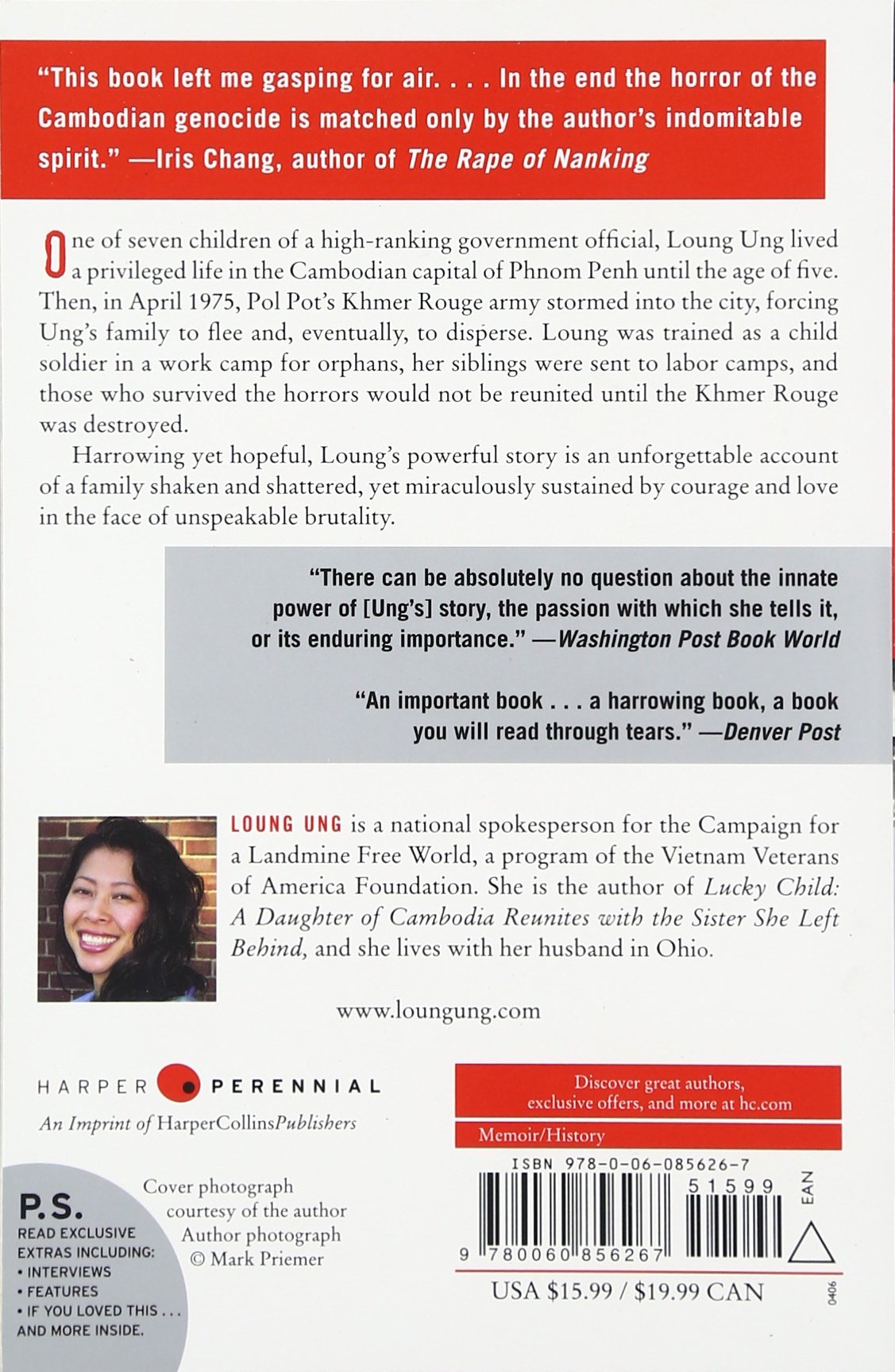
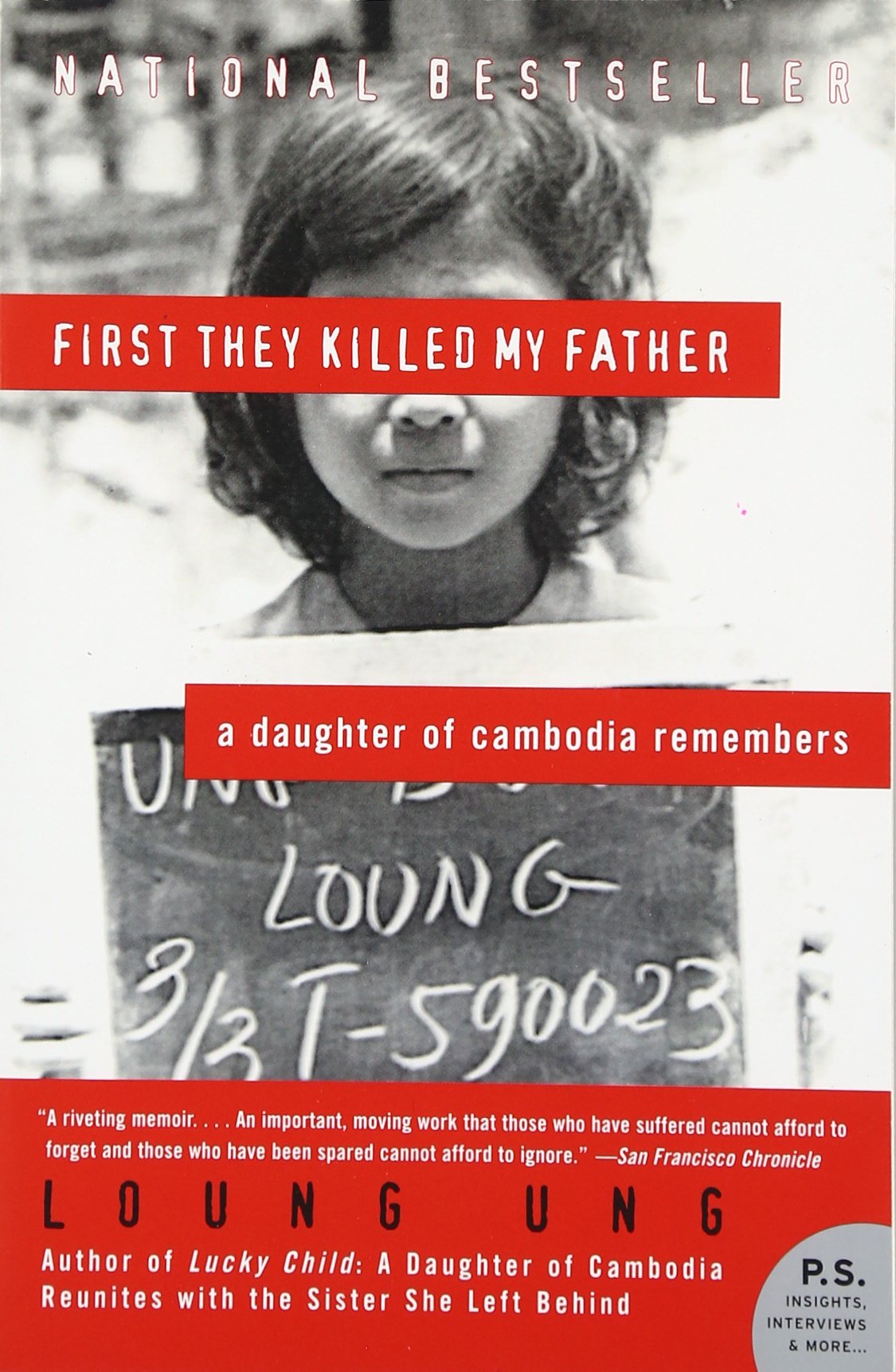
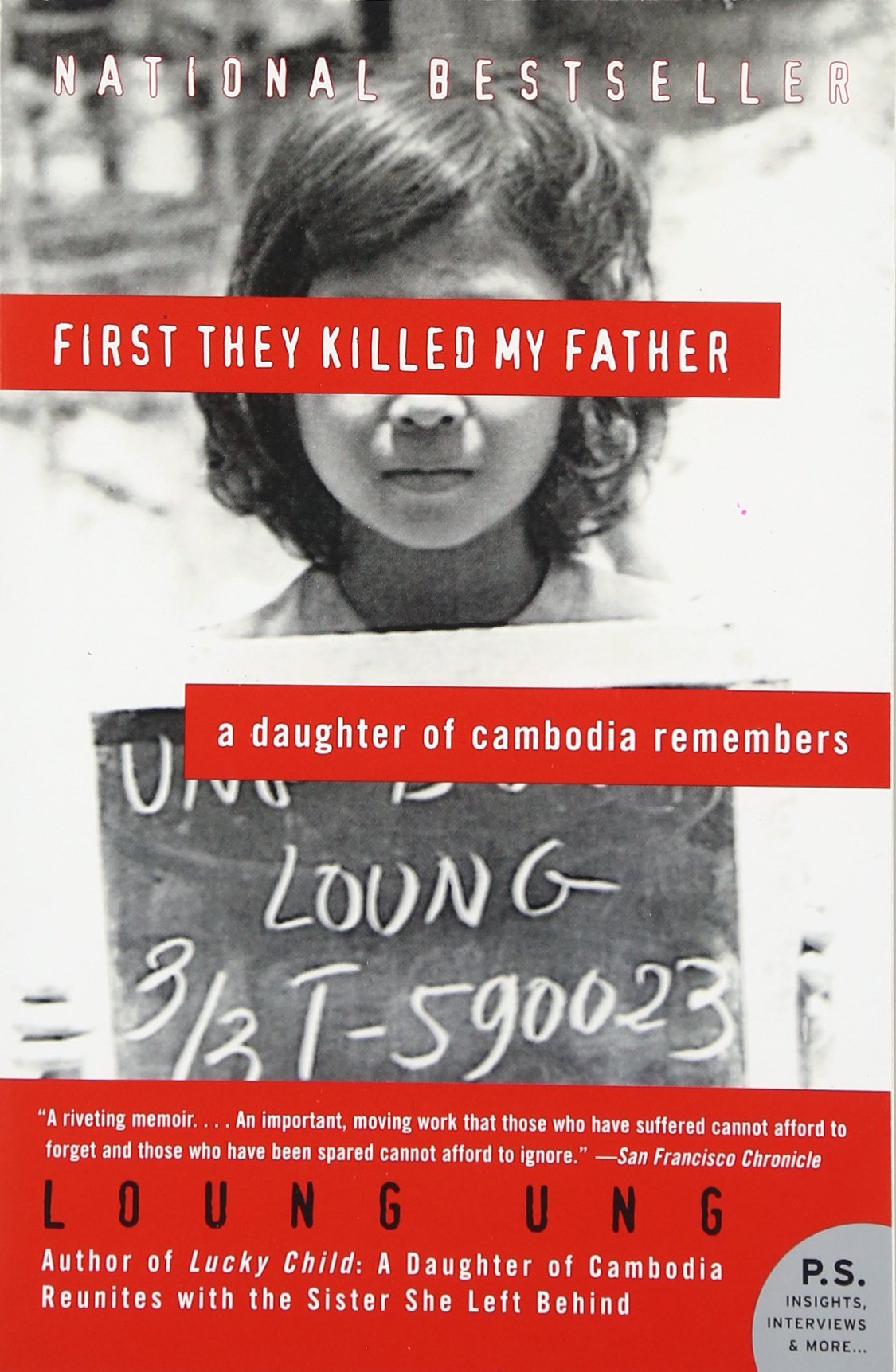
One of seven children of a high-ranking government official, Loung Ung lived a privileged life in the Cambodian capital of Phnom Penh until the age of five. Then, in April 1975, Pol Pot's Khmer Rouge army stormed into the city, forcing Ung's family to flee and, eventually, to disperse. Loung was trained as a child soldier in a work camp for orphans, her siblings were sent to labor camps, and those who survived the horrors would not be reunited until the Khmer Rouge was destroyed.
Harrowing yet hopeful, Loung's powerful story is an unforgettable account of a family shaken and shattered, yet miraculously sustained by courage and love in the face of unspeakable brutality.
Product details
Series: P.S.
Paperback: 238 pages
Publisher: Harper Perennial (April 4, 2006)
Language: English
ISBN-10: 0060856262
ISBN-13: 978-0060856267
Product Dimensions: 5.3 x 0.6 x 8 inches
Shipping Weight: 8 ounces (View shipping rates and policies)
Average Customer Review: 4.6 star See all reviews (489 customer reviews)
Amazon Best Sellers Rank: #6,465 in Books (See Top 100 in Books) #8 in Books > Biographies & Memoirs > Historical > Asia
#28 in Books > History > World > Women in History
#51 in Books > History > Asia
More about the author
Author, lecturer, and activist, Loung Ung has dedicated much of her life to promoting equality and human rights in her native land and worldwide. In recognition of her work, The World Economic Forum selected Loung as one of the “100 Global Youth Leaders of Tomorrow.”
Loung's memoir, First They Killed My Father: a Daughter of Cambodia Remembers (HarperCollins 2000)is a national bestseller and recipient of the 2001 Asian/Pacific American Librarians’ Association award for “Excellence in Adult Non-fiction Literature”, and has been published in Khmer, German, French, Spanish, Italian, Japanese and other languages. She has appeared widely on news programs and other media. She is also the author of Lucky Child and Lulu in the Sky, both published by HarperCollins. she is now working on a novel.
Today, Loung has made over 30 trips back to Cambodia. When not working and traveling, she enjoys eating fried crickets and riding her tandem bike with her husband Mark. Together, they are partners/owners of a trio of restaurants and microbrewery--the Belgian Bier Markt, Bar Cento, and Market Garden Brewery--in Cleveland, Ohio.
Editorial Reviews
Amazon.com Review
Written in the present tense, First They Killed My Father will put you right in the midst of the action--action you'll wish had never happened. It's a tough read, but definitely a worthwhile one, and the author's personality and strength shine through on every page. Covering the years from 1975 to 1979, the story moves from the deaths of multiple family members to the forced separation of the survivors, leading ultimately to the reuniting of much of the family, followed by marriages and immigrations. The brutality seems unending--beatings, starvation, attempted rape, mental cruelty--and yet the narrator (a young girl) never stops fighting for escape and survival. Sad and courageous, her life and the lives of her young siblings provide quite a powerful example of how war can so deeply affect children--especially a war in which they are trained to be an integral part of the armed forces. For anyone interested in Cambodia's recent history, this book shares a valuable personal view of events. --Jill Lightner
--This text refers to the Audio CD edition.
From Publishers Weekly
In 1975, Ung, now the national spokesperson for the Campaign for a Landmine-Free World, was the five-year-old child of a large, affluent family living in Phnom Penh, the cosmopolitan Cambodian capital. As extraordinarily well-educated Chinese-Cambodians, with the father a government agent, her family was in great danger when the Khmer Rouge took over the country and throughout Pol Pot's barbaric regime. Her parents' strength and her father's knowledge of Khmer Rouge ideology enabled the family to survive together for a while, posing as illiterate peasants, moving first between villages, and then from one work camp to another. The father was honest with the children, explaining dangers and how to avoid them, and this, along with clear sight, intelligence and the pragmatism of a young child, helped Ung to survive the war. Her restrained, unsentimental account of the four years she spent surviving the regime before escaping with a brother to Thailand and eventually the United States is astonishing--not just because of the tragedies, but also because of the immense love for her family that Ung holds onto, no matter how she is brutalized. She describes the physical devastation she is surrounded by but always returns to her memories and hopes for those she loves. Her joyful memories of life in Phnom Penh are close even as she is being trained as a child soldier, and as, one after another, both parents and two of her six siblings are murdered in the camps. Skillfully constructed, this account also stands as an eyewitness history of the period, because as a child Ung was so aware of her surroundings, and because as an adult writer she adds details to clarify the family's moves and separations. Twenty-five years after the rise of the Khmer Rouge, this powerful account is a triumph. 8 pages b&w photos.
Copyright 2000 Reed Business Information, Inc.
--This text refers to the Audio CD edition.
Customer Reviews
5.0 star
A timely lesson for today's world
ByDavid Y.on December 22, 2015|Verified Purchase
It has been more than 40 years since the black-uniformed columns of the Khmer Rouge rolled into Phnom Penh and changed the life of a 5-year old girl named Loung Ung forever. With the benefit of distance, it may be all too easy to dismiss the horrors of that era to a distant corner of memory, or to brush it off as a bizarre aberration of history. That would be a mistake. Communism as an ideology may be bankrupt, but the specter of Utopian extremism lives on. Many young men and women who flock to ISIS today are fired by the same misguided zealotry, the same disdain for common human decency in the name of a supposedly better world, that brought young men and women into the folds of the Khmer Rouge 40, 50, and 60 years ago. In fact, the parallels are chilling - like many leading figures of ISIS, Al Qaeda, and the Taliban today, the leaders of the Khmer Rouge were by and large teachers. They wrote beautifully, if somewhat naively, of a return to innocent rural simplicity. They impressed their students with their erudition, simplicity of living, and apparent dedication. How can such earnest people do any wrong? Many will find out at the cost of their lives.
Loung Ung's autobiography is a moving memorial to all the lives lost in that deranged quest for Utopia. In the eyes of the Angkar (the Khmer Rouge "organization"), liquidating the members of the old regime is but a necessary prelude to building a society of true believers. And if the Angkar believes that each hectare can yield 3 tons of rice (even though the best yield before the war was only 1 ton/hectare), then it must be achievable if everybody just works hard enough. The starry-eyed school-teachers of yesteryear who dreamed of an agrarian paradise had become totally out of touch. And with the absolute power they wielded, nobody was about to tell them otherwise. The result was mass famine as local cadres starved the people to turn in their production quota. As millions perished, the top leadership witch-hunted for "saboteurs" and berated their subjects for lack of revolutionary fervor.
Ung's book is full of vivid descriptions and keen observations that bring the vicissitudes of that era poignantly to life. Many passages are naturally cinematic. These include:
- Her idyllic family life in pre-KR Phnom Penh. The author was young, but her memory is sharp. Her colourful description of early 1970's Phnom Penh with its many exotic (to an American audience) sights, sounds, and colors is an adventure in itself;
- The arrival of the KR in Phnom Penh. A moment of high historical drama, but perhaps the author was too young to remember the details. This is where Chanrithy Him's dramatic account offers some truly memorable moments;
- Getting through the KR check points on the way out of Phnom Penh, as KR soldiers systematically rounded up all former members of the old regime. Most would be executed within days;
- A widow who took refuge with the author's family, tenderly talking to the baby that she carried with her everywhere, refusing to accept that he was already dead; (p.86)
- The ritual brainwashing of children at a child labor camp, with the clapping, the chanting of "Angkar!", the endless repetition of propaganda;
- Loung's savage attack against one of her tormentors, a bully in the children's labour camp who despised her because of her light skin. Even as a 7-year old she dreamed of the day when she'd have the power to come back to look for the bullies and "beat them until she was tired". She vowed never to forget. Her sweet-natured sister couldn't understand why she wanted to retain such horrible memories. But as Loung explained, she needed the anger, the thoughts of retribution, to fill the bottomless sadness in her soul.
I've always said that anger, or at least righteous indignation, is a much under-rated emotion. It needs to be controlled. It needs to be properly-channeled. But it's the juice that drives much social progress.
Finally, a few observations about the author's family background. A few readers took offense at the author's perceived lack of sensitivity. Perhaps she took too much pride in her family's light skin, high status, and economic prosperity. Reading her account of her family's encounter with the villagers in the KR base areas, it's quite evident there was much class resentment and perhaps plain-old jealousy on the part of the country folk. Even to this day many villagers in the old KR base areas seem to recall that era wistfully - Pol Pot's cremation site seems to have become something of a shrine. No doubt the villagers didn't enjoy the regimentation, but it was a topsy-turvy time when poor people like themselves could feel superior to the city folk who probably looked down on them. Not that the Khmer Rouge cadres themselves were particularly holy, of course. Plenty were mere opportunists. The Khmer Rouge village chief who lorded over the "new people" ate better, dressed better, and was apparently not above trading extra food for gold at exorbitant prices. (Ironically his corruption probably saved some lives, because life definitely got a lot harder after Angkar tightened things up and sent more soldiers into the villages.) As for Pol Pot, the young Loung Ung knew almost nothing about him, except that he was "fat" in a country of living skeletons.
A postscript: Those readers who are interested in how Loung and her siblings fared after the war may be interested in reading her second book, Lucky Child. While some readers may find the events in her later life less dramatic, I found it equally fascinating to read about her endeavors to come to terms with her past while trying to make a new life for herself in America. Like many children from similar backgrounds, she went through a phase when she attempted to cut all ties with her past (to the point of deliberately avoiding contact with her siblings) and plunged headlong into mainstream American youth culture. As she got older, she discovered that she could only conquer the ghosts of her past by embracing her roots, and to rise above her personal losses (and petty personal vengeance) by making them her life-long cause. While my own life experiences were nowhere nearly as dramatic as Luong's, there are enough similarities that what she wrote rang true to me and resonated. Well worth a read.
5.0 star
***** Five Stars - G-d bless you Loung Ung -The world learned nothing? History is replete with examples of genocide.*****
ByL.I. NY Prof.on August 15, 2014|Verified Purchase
Sobering and current commentary reflecting on the state of the world today. It makes me fearful for the fate of our children. 200,000 Arabs kill other Arabs in Syria, Russians shoot down Malaysian civilian airliner in the Ukraine, Thousands of Christians are forced to relocation camps in Iraq or forced to convert to Islam upon pain of death. But these historic facts are dwarfed by the comparison to the millions of Thais who were brutally slaughtered by the Pol Pot regime. Has the world learned nothing? History is replete with examples of genocide. Remember Hitler learned a great lesson when the world stood by and did nothing as they watched the shameful slaughter of the Armenians at the hands of the Turks. Hitler is quoted saying "the world did nothing for the Armenians" and the world would do nothing to protect the Jews he slaughtered. Pol Pot learned from Hitler and Stalin and the Turks. G-d bless you Loung Ung. People who forget history are doomed to repeat it. The UN is a worthless side show run by counties with their own self interests.
5.0 star
Memoir
ByCharlottekrn Bookfairon May 9, 2017|Verified Purchase
In 2000, Loung Ung published her childhood memoir which quickly became a national bestseller. Loung Ung’s memoir opens to the picture of a happy childhood in Phnom Penh. However the family’s happy existence abruptly changes with the invasion of the Khmer Rouge. The author describes the tragedy that befell her family and her fellow Cambodians during the nightmarish rule under Pol Pot’s reign of terror in the 1970’s. Ms. Ung relates their struggle to survive and the decisions they made which dictated their future. The author covers the invasion of the Vietnamese army who defeat the Khmer Rouge and of her reunification with her siblings. Loung Ung’s memoir, though she lived through horrific experiences, speaks to endurance, and to the love of family. Recommended.